

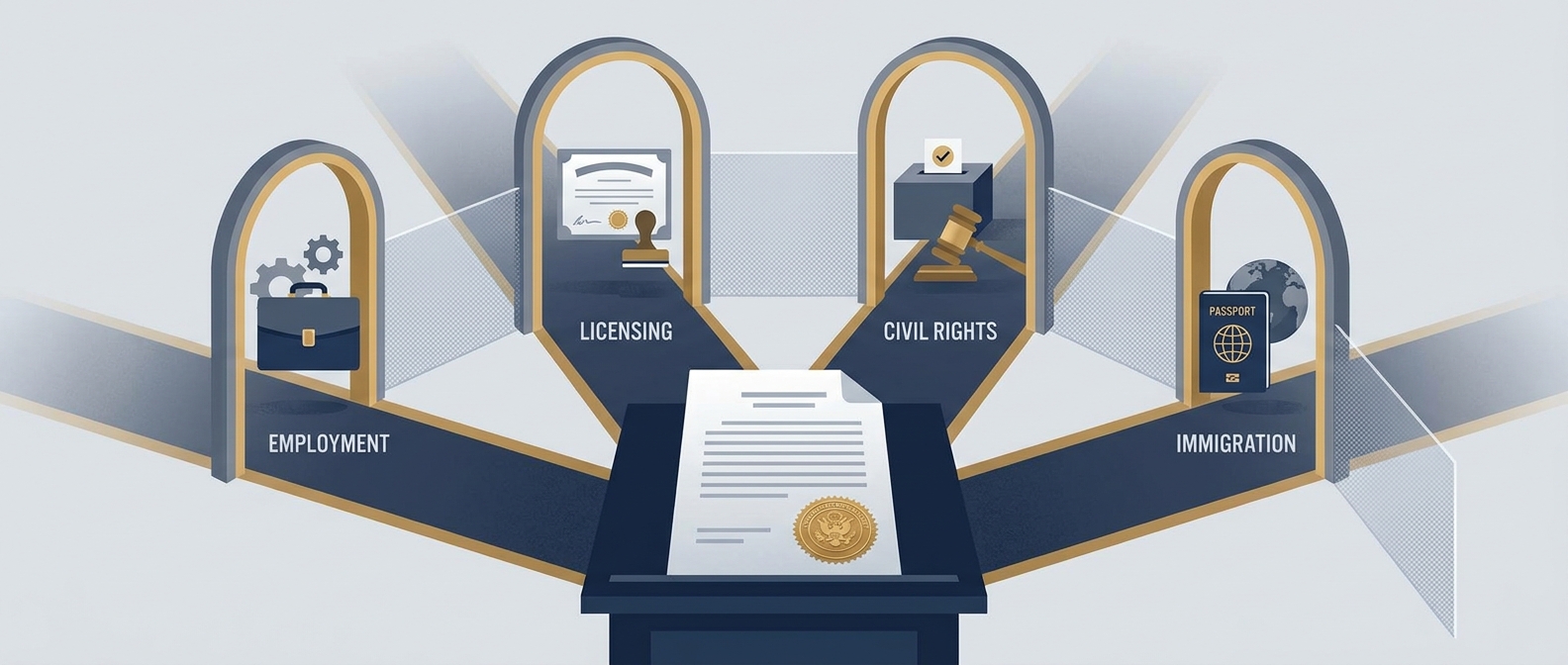
A federal conviction does not end when the prison term does. For most people, the consequences that shape daily life for years afterward are not the sentence itself but everything that travels with the conviction — the supervision that follows release, the loss of certain rights, the doors that close on careers and licenses, and, for noncitizens, the threat of removal from the country. Lawyers call these collateral consequences, and they are often the part of a federal case that clients understand the least at the outset.
This hub maps the collateral consequences of a federal conviction in plain terms. It explains supervised release and probation, sex-offender registration under SORNA, the loss of civil rights, professional licensing and career impact, immigration exposure, firearm consequences, and the limited routes for clearing or easing a record. It is grounded in the federal sentencing statutes, the Supreme Court’s decision in Padilla v. Kentucky on the immigration consequences of a plea, and the federal courts’ treatment of each issue. Elizabeth Franklin-Best, P.C., handles federal criminal defense and post-conviction matters nationwide. Principal attorney Elizabeth Franklin-Best holds a 2026 “Best Lawyer” listing in Appellate Practice from Best Lawyers in America together with a Chambers USA 2026 ranking for Litigation: White-Collar Crime & Government Investigations, and this resource — informed by federal prison and reentry authority Christopher Zoukis, our Managing Director — reflects how the firm helps clients see the full picture.
If you are facing a federal charge or living with a conviction and want to understand the consequences that lie ahead — and what can be done about them — the firm offers a paid, one-hour initial consultation to review your situation.
What This Guide Covers
Quick Answer: Collateral Consequences
| Question | Answer |
|---|---|
| What are collateral consequences of a federal conviction? | They are the legal penalties and disabilities that flow from a conviction but are not part of the pronounced sentence — including loss of rights, licensing bars, immigration exposure, and firearm prohibitions. |
| Is supervised release a collateral consequence? | Supervised release is technically part of the sentence under 18 U.S.C. § 3583, but it shapes life after release much like a collateral consequence and is covered here for that reason. |
| Can a federal conviction lead to deportation? | Yes. Under 8 U.S.C. § 1227, many convictions make a noncitizen deportable, and some categories carry near-automatic removal consequences. |
| Does a conviction always cost me my right to vote? | Not always. Voting eligibility is governed largely by state law, and states differ on whether and when the franchise is lost and restored. |
| Can a federal conviction be expunged? | Rarely. There is no general federal expungement statute, and federal courts generally cannot expunge a valid conviction on equitable grounds. |
| Where do I start? | With a paid, one-hour initial consultation that inventories the consequences in play for you and ranks the remedies worth pursuing. |
Key Takeaways
- Collateral consequences are the legal penalties that flow from a conviction but are not part of the pronounced sentence.
- Padilla v. Kentucky requires defense counsel to advise noncitizen clients of the deportation risk associated with a plea, recognizing the severity of that consequence.
- Supervised release under 18 U.S.C. § 3583 is a separate component of the sentence served after imprisonment, not parole, and not a reduction of the prison term.
- Federal probation under 18 U.S.C. § 3561 is a sentence imposed instead of incarceration, distinct from supervised release.
- Supervision can sometimes be shortened or lightened through a motion for early termination or a motion to modify conditions.
- SORNA sorts qualifying sex offenses into three tiers that determine how long registration lasts and how often a registrant must verify in person.
- A felony conviction can cost civil rights — voting, jury service, office-holding — under a mix of state and federal law.
- Professional licensing consequences vary widely; some are automatic, others discretionary, and state boards govern many.
- A conviction triggers the federal firearms bar under 18 U.S.C. § 922(g)(1), and restoring firearm rights is difficult.
- The federal system has no general expungement statute; clemency and post-conviction relief are the main routes for easing or undoing a conviction.
- Collateral consequences should be analyzed before a plea, when the charge and sentencing strategy can still account for them.
What Are Collateral Consequences?
Collateral consequences are the legal disabilities and penalties that flow from a criminal conviction but are not part of the sentence the judge pronounces. A federal sentence has direct components — imprisonment, fines, restitution, and a term of supervised release. Collateral consequences are everything else the conviction triggers: a professional license revoked by a state board, the loss of the right to vote or possess a firearm, ineligibility for certain benefits or housing, removal from the United States, and the ongoing burden of a public criminal record.
For decades, courts drew a sharp line between “direct” consequences — which a defendant must understand before pleading guilty — and “collateral” ones, which generally did not have to be explained. That line has eroded in one critically important area. In Padilla v. Kentucky, 559 U.S. 356 (2010), the Supreme Court held that defense counsel has a Sixth Amendment duty to advise a noncitizen client about the deportation risk a guilty plea carries, recognizing that deportation is a uniquely severe penalty closely tied to the criminal process. Padilla did not erase the distinction between direct/collateral consequences everywhere, but it confirmed that some collateral consequences are too serious to treat as afterthoughts.
The practical lesson is the one this hub is built around: collateral consequences should be analyzed early, not discovered late. The right time to weigh how a conviction will affect a license, a green card, or the right to own a firearm is before a plea is entered and a sentence is imposed — when the charge, the plea terms, and the sentencing strategy can still be shaped with those consequences in view. This hub surveys each major category and explains the issues that most often determine what life looks like after a federal case.
The scale of these consequences is easy to underestimate. In United States v. Nesbeth, 188 F. Supp. 3d 179 (E.D.N.Y. 2016), Judge Frederic Block surveyed the field and counted nearly 50,000 federal and state statutes and regulations that impose penalties or disabilities on people with convictions — roughly 1,200 of them federal — and observed that some 70 to 100 million Americans now carry a record that triggers some of them. He described the modern web of collateral consequences as a kind of “civil death” and treated its weight as relevant to a just sentence under 18 U.S.C. § 3553(a). That insight matters in two directions: collateral consequences can become an argument for a lower sentence, and they are a reason to map the full landscape before a plea rather than after one.
Applied Insight: In the firm’s experience, the consequences clients most regret overlooking are rarely the obvious ones. It is the licensing board that quietly revokes a credential, the immigration exposure that surfaces years later, or the firearm prohibition no one flagged. Building a collateral-consequences analysis into a case from the start is one of the most valuable things a defense effort can do.
Supervised Release and Probation
The most immediate consequence of a federal conviction, for almost everyone who serves time, is supervision. Federal supervised release is governed by 18 U.S.C. § 3583. It is a distinct component of the sentence — imposed, in the statute’s words, “as a part of the sentence” and served after imprisonment, in addition to it. It is not parole, and it does not shorten the prison term; it is a separate period of court supervision that begins on release.
During supervised release, a person lives under conditions set by the court — reporting to a probation officer, restrictions on travel and employment, drug testing, and often offense-specific terms. Violating those conditions can lead to a supervised release violation proceeding under § 3583(e), where a judge can revoke release and impose additional imprisonment. Because the standard of proof at a revocation hearing is lower than at trial, these proceedings carry real risk and deserve serious defense.
Federal probation, governed by 18 U.S.C. § 3561, is different. Probation is a sentence in itself — a term of court supervision imposed instead of incarceration, not after it. It is available for some offenses but not others, and it comes with its own conditions and revocation exposure.
Supervision is not necessarily fixed for its full term. Two motions can change it. A motion for early termination of supervised release under § 3583(e)(1) asks the court to end supervision ahead of schedule, and a motion to modify supervised release conditions under § 3583(e)(2) asks the court to change or remove specific conditions. The firm pursues both, and both can meaningfully shorten or lighten the supervision that follows a conviction.
What Changed in Supervised Release: The 2025 Rules
Supervised release law moved more in 2025 than it had in decades, and the changes favor individualized treatment. Effective November 1, 2025, the United States Sentencing Commission amended the supervised release guidelines across Chapter Five, Part D and Chapter Seven. Under the revised §5D1.1, courts are no longer directed to impose supervised release whenever the prison sentence exceeds one year; supervision is now called for only when a statute requires it or when an individualized assessment — keyed to the 18 U.S.C. § 3553(a) factors — shows a genuine need for it. The Commission adopted the change in response to data showing courts were imposing supervision in 82.5 percent of cases, often by default. The amendment likewise replaces the old offense-class-based recommended terms in §5D1.2 with an individualized determination of length, and §5D1.3 now provides that even the “standard” conditions may be modified, omitted, or expanded case by case.
Just as important for people already on supervision, the amendment adds a new policy statement, §5D1.4, squarely addressing life after sentencing. It encourages courts — in consultation with the probation officer — to revisit conditions once a person is actually released, and it restates and structures the court’s authority to modify conditions under § 3583(e)(2) and to terminate supervision early under § 3583(e)(1) after one year, listing factors that support termination. Because judges deciding these motions consult the policy statements in effect at the time of the motion, the new framework strengthens early-termination and modification arguments even for clients sentenced years ago.
The Supreme Court added its own correction the same year. In Esteras v. United States, 606 U.S. 185 (2025), the Court held that a judge deciding whether to revoke supervised release under § 3583(e) may not consider retribution for the underlying offense — the factor listed in § 3553(a)(2)(A) — because the statute’s list of permissible considerations is exhaustive and omits it. Revocation decisions must rest on forward-looking concerns: deterrence, protection of the public, and rehabilitation. For anyone facing a violation proceeding, Esteras gives the defense a clear objection when a court reaches back to punish the original crime a second time.
Sex Offender Registration and SORNA
For anyone convicted of a qualifying sex offense, registration is among the most far-reaching collateral consequences of all. The federal framework is the Sex Offender Registration and Notification Act — SORNA — codified at 34 U.S.C. § 20901 and following. SORNA establishes a national standard for who must register, what information is collected, how long registration lasts, and how often a registrant must verify their information in person.
SORNA sorts qualifying offenses into three tiers, and the tier determines the duration and frequency of registration — generally 15 years, 25 years, or life, with corresponding in-person verification intervals. Registration obligations follow a person across state lines, and a knowing failure to register or update can be prosecuted as a separate federal offense under 18 U.S.C. § 2250, carrying its own term of imprisonment on top of the original sentence.
Registration is also one of the consequences most worth understanding before a plea. Whether an offense qualifies and at what tier can turn on the precise charge of conviction, meaning careful charge and plea analysis can sometimes influence it.
Applied Insight: Registration consequences are frequently the difference between two plea options that look similar on their face. Two charges can carry comparable prison exposure yet place a person in entirely different SORNA tiers. Analyzing that difference before a plea — not after — is exactly the kind of collateral-consequence work that shapes the rest of a client’s life.
Loss of Civil Rights
A felony conviction can strip a person of core civil rights — the right to vote, serve on a jury, and hold public office. These losses are real, but they are also widely misunderstood, because they are governed by a patchwork of federal and state law rather than a single rule.
Voting is the clearest example. Eligibility to vote is set largely by the states, and states differ sharply in whether and when a person with a felony conviction loses and regains the franchise. Some automatically restore voting rights upon completion of the sentence; others require a separate step. Jury service and office-holding follow their own rules, several of them federal. Under 28 U.S.C. § 1865(b)(5), anyone convicted of a crime punishable by more than one year in prison is disqualified from federal grand and petit jury service unless their civil rights have been restored — and that disqualification applies even if the sentence imposed no prison time at all. Office-holding bars attach to certain federal offenses, and the answer for any given right turns on the interplay of federal law and the law of the state where a person lives.
Professional Licensing and Career Impact
For many people facing a federal charge — particularly in white-collar matters — the consequence that worries them most is their livelihood. A conviction can jeopardize professional licenses in fields from finance, law, and healthcare to real estate, accounting, and government contracting. It can trigger debarment from federal contracts, exclusion from federal health care programs, and the loss of securities industry registration.
The mechanics vary. Some licensing rules impose an automatic bar tied to the existence of a conviction; others give a board discretion to weigh the offense, the conduct, and the applicant’s history. A few consequences flow from federal regulatory action rather than a state board at all. Because the rules are scattered across agencies and professions, the impact on any given career has to be analyzed individually. Healthcare professionals face mandatory exclusion from Medicare and Medicaid under 42 U.S.C. § 1320a-7, those in banking confront the bar in 12 U.S.C. § 1829, and securities-industry registrations can be lost to statutory disqualification — so the licensing fallout of a conviction has to be analyzed profession by profession, and it can sometimes be limited.
Immigration Consequences
For a noncitizen — including a lawful permanent resident — a federal conviction can be the single most consequential event of the entire case, because it can mean removal from the United States. Under 8 U.S.C. § 1227, a wide range of convictions render a noncitizen deportable, and certain categories, such as an “aggravated felony” or a controlled-substance offense, carry especially harsh and sometimes near-automatic immigration consequences.
This is the area where the law most clearly recognizes the weight of a collateral consequence. Padilla v. Kentucky requires defense counsel to advise a noncitizen client about the deportation risk of a plea, and the Supreme Court has stressed that bringing immigration consequences into plea negotiations benefits everyone involved. The immigration definition of a disqualifying offense does not always match its label in the criminal code, so the analysis is technical and unforgiving. The categories of removability are technical and the stakes are high, which is why charge selection and plea structure can be decisive for a noncitizen defendant — and why the criminal defense and any immigration analysis need to run together from the first day.
The reason the analysis is so technical is what courts call the categorical approach: immigration consequences generally turn on the elements of the offense of conviction — what the statute required the government to prove — rather than on what the person actually did. Two statutes covering similar conduct can therefore produce opposite immigration outcomes, and the aggravated-felony definitions in 8 U.S.C. § 1101(a)(43) reward element-by-element comparison before any plea is entered. This is precisely why a noncitizen client needs the criminal defense and the immigration analysis running in tandem, not in sequence.
Applied Insight: For a noncitizen client, the immigration consequence often outranks the prison term in importance — a shorter sentence is little comfort if the conviction guarantees removal. The strongest defense work in these cases treats avoiding a removable conviction as a primary objective from the first day, coordinating the criminal strategy with the immigration stakes.
Firearm Rights
A felony conviction triggers the federal firearms prohibition in 18 U.S.C. § 922(g)(1), which makes it unlawful for a person convicted of a crime punishable by more than a year in prison to possess a firearm or ammunition. The bar is broad, and a violation is a serious federal felony in itself.
Restoring firearm rights after a federal conviction is difficult. The definition of “conviction” in 18 U.S.C. § 921(a)(20) excludes a conviction that has been expunged or set aside, or for which the person has been pardoned or had civil rights restored — unless the relief expressly bars firearm possession. There is also a federal relief statute, 18 U.S.C. § 925, though the application path for individuals has long been constrained by funding limits. Because a wrong assumption here can mean a new prosecution, restoration of firearm rights is an area for careful, individualized analysis rather than guesswork.
This area of law is now genuinely in motion. Since New York State Rifle & Pistol Assn., Inc. v. Bruen, 597 U.S. 1 (2022), firearm regulations must be justified by the Nation’s historical tradition, and in United States v. Rahimi, 602 U.S. 680 (2024), the Supreme Court upheld disarming people subject to domestic-violence protective orders while leaving the fate of other prohibitions open. Applying that framework en banc, the Third Circuit held in Range v. Attorney General, 124 F.4th 218 (3d Cir. 2024), that § 922(g)(1) was unconstitutional as applied to a man whose only conviction was a decades-old, nonviolent food-stamp offense. The court called its holding narrow, but it has fueled a circuit-by-circuit debate over as-applied challenges by nonviolent offenders — a debate with obvious significance for white-collar clients.
The regulatory picture shifted in 2025 as well. The Department of Justice moved to revive the long-dormant § 925(c) relief process, withdrawing the decades-old delegation of that authority to ATF in March 2025 and proposing a new application framework administered by the Attorney General later that year. The final rule is still pending, but the Attorney General began granting individual restorations in early 2026 — the first federal administrative relief of this kind in a generation — and additional grants followed in May 2026. We watch these developments closely because they change what restoration advice should say.
The Same Conviction, Different Definitions
One of the most counterintuitive features of collateral-consequence law is that the word “conviction” does not mean the same thing in every regulatory regime. A disposition that clears a person under one body of law can leave them fully exposed under another, because each statute defines the triggering event for itself. The result is that the same plea can carry different consequences depending on which agency is asking, and a remedy that solves one problem may do nothing for the next.
Healthcare is the starkest example. The mandatory-exclusion statute, 42 U.S.C. § 1320a-7(i), defines “convicted” to include not only entered judgments but findings of guilt, guilty and no-contest pleas, and even deferred-adjudication and first-offender arrangements in which judgment is withheld — and it reaches convictions that have later been expunged. A healthcare professional who accepts a deferred disposition believing it avoids a conviction can still face exclusion from Medicare and Medicaid. Firearms law runs the other way: the definition in 18 U.S.C. § 921(a)(20) can disregard a conviction that has been expunged, set aside, pardoned, or followed by a restoration of civil rights — provided the relief does not itself reserve a firearms bar. Immigration law takes yet a third position: under the definition at 8 U.S.C. § 1101(a)(48), a conviction generally remains a conviction even after a state expungement, with only a narrow exception for certain first-offender drug dispositions.
The practical takeaway is that record relief has to be matched to the specific disability a client wants to lift. A state expungement may restore firearm eligibility yet leave a healthcare exclusion and a deportation ground untouched. Before negotiating a plea or pursuing post-judgment relief, the defense has to ask which definition of “conviction” controls each consequence in play — because clearing the record in one forum is not the same as clearing it everywhere.
Clearing or Easing a Federal Record
The final question most people ask is whether the record itself can ever be cleared. The honest answer for federal convictions is sobering: the federal system has no general expungement statute, and federal courts generally cannot expunge a valid conviction to reward rehabilitation. The narrow exception is 18 U.S.C. § 3607(c), which allows expungement for certain first-time, simple drug-possession dispositions by young offenders; outside that provision, record relief in federal court is rarely realistic.
What the federal system does offer is clemency. A presidential pardon does not erase a conviction; it forgives it and lifts many of the legal disabilities associated with it. For someone whose conviction may have been legally flawed, post-conviction relief aimed at vacating the conviction is a different and often stronger route. Matching the goal — easing supervision, restoring a right, clearing a record, or undoing a conviction — to the correct remedy is the heart of post-conviction strategy, and it connects directly to the firm’s broader federal criminal defense practice.
Collateral Consequences Guides
Each collateral consequence introduced above has its own in-depth guide. The pages below go deeper into the statutes, tiers, timelines, and remedies that shape life after a federal conviction, and they explain the motions and relief the firm pursues in each area. Use them to understand the specific consequence you are facing and the routes that may be available to limit or lift it.
- Federal Supervised Release — what supervised release is, how long it lasts, the conditions imposed under 18 U.S.C. § 3583, and how it differs from probation and parole.
- Federal Probation — when probation is available under 18 U.S.C. § 3561, the conditions it carries, and how it differs from supervised release served after imprisonment.
- Supervised Release Violations — how a revocation proceeding works under 18 U.S.C. § 3583(e), the additional prison time a violation can carry, and how a violation is defended.
- Early Termination of Supervised Release — the 18 U.S.C. § 3583(e)(1) standard, the one-year threshold, and what courts look for in a motion to end supervision ahead of schedule.
- Modifying Supervised Release Conditions — how to change or remove specific conditions under 18 U.S.C. § 3583(e)(2), the grounds courts accept, and how the motion process works.
- Sex Offender Registration and SORNA — the three-tier system, how long registration lasts, the in-person verification requirements, and the consequences of failing to register.
- Loss of Civil Rights — how a federal conviction affects the right to vote, serve on a jury, and hold public office, and how civil rights can be restored.
- Professional Licensing and Career Impact — automatic bars, discretionary board review, healthcare program exclusion, banking disqualification, and federal debarment.
- Immigration Consequences — the deportability grounds under 8 U.S.C. § 1227, aggravated felonies, the categorical approach, and why charge selection is decisive for noncitizens.
- Firearm Rights and Restoration — how 18 U.S.C. § 921(a)(20) and § 925 work, the limits on restoring gun rights, and the realistic routes to relief after a conviction.
- Expungement and Record Sealing — whether a federal conviction can be expunged, the narrow 18 U.S.C. § 3607 exception, the rules for arrest records, and the realistic alternatives.
Frequently Asked Questions
What is the difference between a direct consequence and a collateral consequence?
A direct consequence is part of the sentence itself — imprisonment, a fine, restitution, supervised release. A collateral consequence is a legal penalty or disability that flows from the conviction but is not pronounced by the judge, such as loss of a professional license, loss of voting rights, immigration removal, or a firearms prohibition.
Are collateral consequences part of my criminal sentence?
Generally no. Most collateral consequences are imposed by other bodies of law — immigration statutes, state licensing rules, firearms statutes — rather than by the sentencing judge. Supervised release is an exception in form, since it is technically part of the sentence, but it functions much like a collateral consequence in shaping life after release.
Why should collateral consequences be considered before a guilty plea?
Because once a plea is entered and a conviction stands, the collateral consequences attach automatically. The time to influence whether a conviction triggers deportation, a licensing bar, or a registration requirement is before the plea, when the charge of conviction and plea terms can still be negotiated with those consequences in view.
Can a federal conviction get me deported?
Yes. Under 8 U.S.C. § 1227, a wide range of convictions make a noncitizen — including a lawful permanent resident — deportable. Certain categories, such as aggravated felonies or controlled substance offenses, carry especially harsh consequences, sometimes near-automatic removal.
Is supervised release the same as parole?
No. Federal parole was largely abolished for offenses committed after the mid-1980s. Supervised release under 18 U.S.C. § 3583 is a separate term of court supervision that begins after a person completes the prison sentence — it does not shorten the prison term as parole once did.
What is the difference between supervised release and probation?
Supervised release follows a term of imprisonment and is served in addition to it. Federal probation, under 18 U.S.C. § 3561, is a sentence imposed instead of incarceration. Both involve court supervision and conditions, but they occupy different places in the sentencing structure.
Can I shorten my term of supervised release?
Sometimes. Under 18 U.S.C. § 3583(e)(1), a court may grant early termination of supervised release after one year of supervision if it is warranted by the person’s conduct and the interests of justice. A separate motion under § 3583(e)(2) can ask the court to modify or remove particular conditions.
Will a federal conviction cost me my professional license?
It can. The impact depends on the profession and the licensing rules. Some rules impose an automatic bar tied to a conviction; others give a board discretion to weigh the offense and the applicant’s history. State boards govern many licenses, so the analysis has to be done profession by profession.
Does a federal conviction permanently take away my right to vote?
Not necessarily. Voting eligibility is set largely by state law, and states differ widely. Some restore the right automatically once a sentence is complete; others require a separate restoration step. The answer depends on the state you live in.
Can my firearm rights be restored after a federal conviction?
It is difficult. A federal conviction triggers the firearms bar in 18 U.S.C. § 922(g)(1). Relief can come through a pardon, expungement, or restoration of civil rights under 18 U.S.C. § 921(a)(20). There is also a federal relief statute at § 925, but the realistic paths are narrow and require careful analysis before relying on them.
Can a federal criminal record ever be cleared?
The federal system lacks a general expungement statute, and federal courts generally cannot expunge a valid conviction solely for rehabilitation. Narrow exceptions exist, chiefly a first-offender provision for certain simple drug-possession cases. A presidential pardon can forgive a conviction, and post-conviction relief can, in some cases, vacate one.
How can a lawyer help with collateral consequences?
A lawyer can analyze the full range of consequences before a plea, shape charge and sentencing strategy to limit them, defend supervised-release violation proceedings, and pursue available relief — early termination, modification of conditions, clemency, or post-conviction remedies — afterward. The goal is to match each remedy to the consequence the client most needs to address.
How did the 2025 Guidelines amendments change supervised release?
Effective November 1, 2025, the Sentencing Commission rewrote the supervised release guidelines around individualized assessment. Courts are no longer directed to impose supervised release whenever the prison sentence exceeds one year — supervision should be ordered only when a statute requires it or when an individualized assessment shows a need. A new policy statement also encourages courts to revisit conditions after release and to consider early termination in appropriate cases.
Can a judge punish me again for my original crime when revoking supervised release?
Not as retribution. In Esteras v. United States, decided in 2025, the Supreme Court held that a court deciding whether to revoke supervised release may not consider retribution for the underlying offense. Revocation must rest on forward-looking factors such as deterrence, protecting the public, and rehabilitation.
Does an expunged conviction still count against me for licensing or immigration?
It can, because federal statutes define “conviction” differently. The healthcare exclusion law at 42 U.S.C. § 1320a-7(i) expressly reaches expunged convictions and even deferred adjudications, so an expungement may not protect a Medicare or Medicaid provider. Immigration law generally does not recognize a state expungement either. Firearms law is more forgiving and can disregard an expunged or set-aside conviction. Because the same disposition can have different effects in different systems, record relief has to be matched to the specific consequence you want to lift.
What did the Range decision mean for gun rights after a federal conviction?
In Range v. Attorney General, decided in 2024, the en banc Third Circuit held that the federal firearms ban in 18 U.S.C. § 922(g)(1) was unconstitutional as applied to a man whose only disqualifying offense was a decades-old, nonviolent food-stamp fraud. The court called the ruling narrow, and it binds only the Third Circuit, but it opened the door to as-applied Second Amendment challenges by people with nonviolent records — an area that remains unsettled and is being litigated circuit by circuit. Whether such a challenge is available depends heavily on the offense and the jurisdiction.
How Our Firm Helps With Collateral Consequences
The most effective time to address collateral consequences is before a conviction is final — when charge selection, plea terms, and sentencing strategy can still be shaped around them. Elizabeth Franklin-Best, P.C., builds that analysis into a case from the start, weighing how each option would affect a client’s license, immigration status, firearm eligibility, and registration exposure. After a conviction, the firm pursues the available relief, including motions to terminate or modify supervised release, clemency petitions, and post-conviction remedies, matching each tool to the consequence the client most needs to resolve.
That work draws on a deep post-conviction and sentence-relief practice. Our principal attorney, Elizabeth Franklin-Best, has handled more than 330 federal proceedings — over 100 of them appeals — and is admitted to the United States Supreme Court and all twelve federal courts of appeals, appearing pro hac vice from Montana to Florida. Much of that record runs through exactly the post-judgment terrain this hub describes: she served as counsel in Aiken v. Byars, 410 S.C. 534 (2014), the landmark decision requiring individualized resentencing for juveniles serving life, and represented the petitioner in King v. Riley, 76 F.4th 259 (4th Cir. 2023), a federal post-conviction challenge — the same machinery used to revisit a sentence, reopen a conviction, and lift the consequences that follow. Her practice spans federal sentencing, First Step Act resentencings, Amendment 821 reductions, and compassionate release, alongside the recognition of a 2026 “Best Lawyer” listing in Appellate Practice from Best Lawyers in America and a Chambers USA 2026 ranking in Litigation: White-Collar Crime & Government Investigations. We do not promise outcomes; we bring that experience to bear on limiting and, where the law allows, undoing the collateral fallout of a conviction.
Talk With a Federal Criminal Defense Lawyer
If a federal case — pending or long past — is still dictating where you can work, what rights you hold, or whether you can stay in this country, bring it to us. In a paid, one-hour initial consultation, we map every consequence your conviction triggers and give you a candid ranking of the relief worth pursuing, from early termination and modification to clemency and post-conviction challenges.