

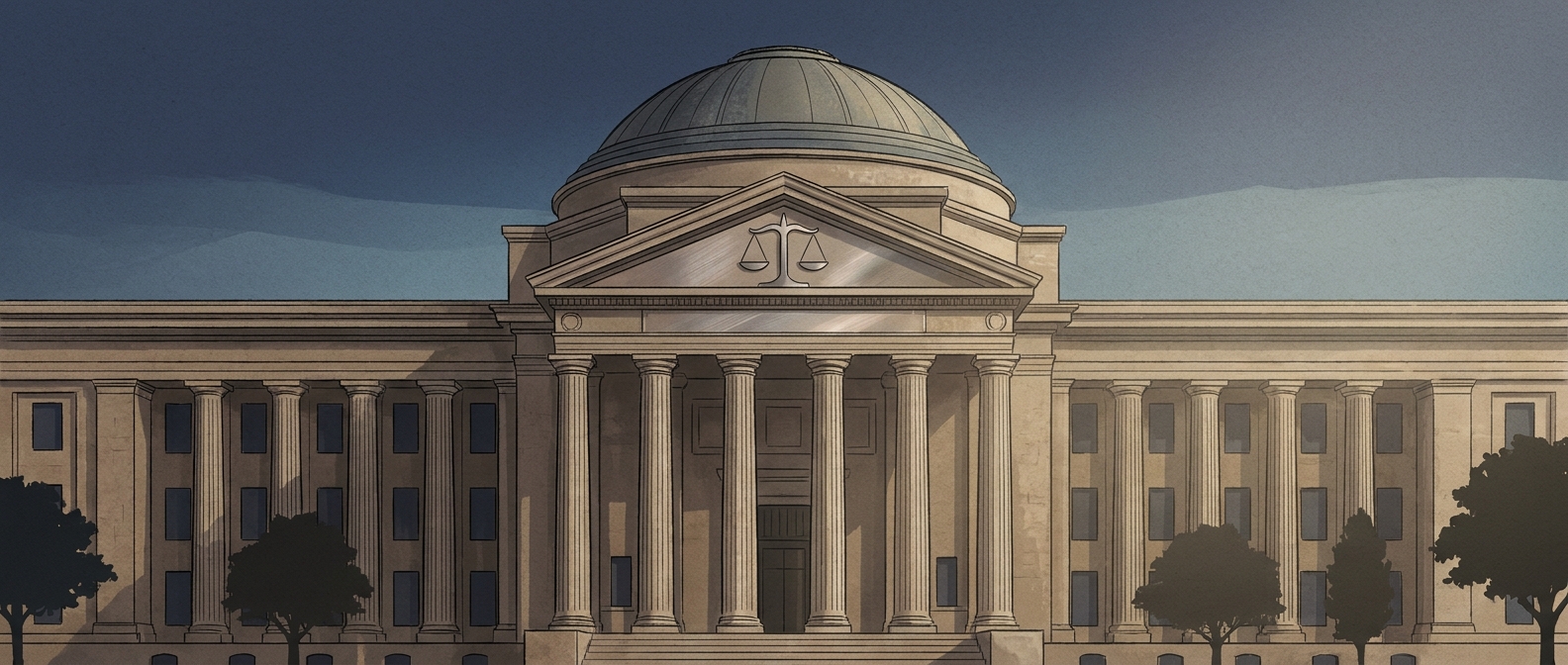
When federal prosecutors charge someone in Utah, the case lands in the United States District Court for the District of Utah — a single statewide district that sits at the United States Courthouse in downtown Salt Lake City, with a southern location in St. George. Its five-judge bench works through one of the heavier single-state criminal dockets in the Tenth Circuit, and its fraud cases in particular carry a distinctly Utah character that defense counsel needs to understand from day one.
This guide walks through the court itself, the U.S. Attorney’s Office and its newly confirmed leadership, the affinity-fraud enforcement culture that shapes Utah’s white-collar docket, and the pro hac vice mechanics by which our firm appears here. Elizabeth Franklin-Best, P.C. handles federal criminal defense, appeals, and post-conviction matters nationwide. Our principal attorney, Elizabeth Franklin-Best, has handled more than 330 federal proceedings — over 100 of them appeals — and has appeared in all twelve federal circuits and at the U.S. Supreme Court, with a nationwide practice in Section 2255 motions, capital habeas, First Step Act resentencings, and compassionate release. Best Lawyers in America selected her as a 2026 “Best Lawyer” in Appellate Practice, and Chambers USA 2026 ranks her in Litigation: White-Collar Crime & Government Investigations. This page is part of our federal courts directory.
If you have received a grand jury subpoena or target letter, or charges have been filed against you in the District of Utah, we offer a paid, one-hour initial consultation to assess the matter and chart the defense.
Table of Contents
Quick Answer: District of Utah
| Question | Answer |
|---|---|
| What court handles federal cases in Utah? | The U.S. District Court for the District of Utah — the entire state in one district, holding court at the United States Courthouse on West Temple in Salt Lake City and at its southern location in St. George. |
| How is the bench structured? | Five authorized judgeships under 28 U.S.C. § 133, led as of mid-2026 by Chief Judge Jill N. Parrish, with six senior judges and five magistrate judges carrying substantial caseloads. |
| Who prosecutes federal cases there? | The U.S. Attorney’s Office for the District of Utah under Melissa Holyoak, who was confirmed by the Senate on May 18, 2026, and sworn in ten days later. |
| How busy is the district? | Busier than its neighbors: 653 people were sentenced here in FY2024 — more than Colorado and Wyoming combined — with drug trafficking at 35.5% and firearms at 26.6%, double the national share. |
| Why is fraud a Utah signature? | Affinity fraud — investment schemes spread through trusted community and religious networks — has long been a regulatory warning theme in Utah, and the district has produced some of the largest federal fraud prosecutions in the country. |
| Which circuit hears appeals? | The Tenth Circuit in Denver, which also covers Colorado, Kansas, New Mexico, Oklahoma, and Wyoming. |
| Can our firm appear in the District of Utah? | Yes. Under DUCivR 83-1.1, out-of-state counsel are admitted pro hac vice in association with local counsel, who files the routine motion — a structure we work within regularly. |
| What is the first step? | A paid, one-hour initial consultation: we examine the subpoena, target letter, or indictment and map the strategy before anything is filed. |
Key Takeaways
- Utah is one federal judicial district with two statutory divisions under 28 U.S.C. § 125 — and Congress expanded the Central Division’s statutory seats to include St. George, Moab, and Monticello effective January 4, 2025.
- In practice the court sits at the United States Courthouse in Salt Lake City — the only federally owned facility the district court uses, by its own description — and in St. George.
- Five district judgeships are authorized by 28 U.S.C. § 133; Chief Judge Jill N. Parrish leads the bench as of mid-2026, with six senior judges adding unusual depth.
- The FY2024 numbers are striking: 653 people sentenced — more than the Colorado and Wyoming federal courts combined — with firearms at 26.6%, twice the national share.
- Guilty pleas resolved 98.5% of sentenced cases in FY2024, so outcomes here are usually won in charge negotiations and at sentencing, not in front of juries.
- Melissa Holyoak became Utah’s Senate-confirmed U.S. Attorney in May 2026, taking over an office with a long-running focus on investment fraud.
- Affinity fraud — schemes that spread through trusted religious and community networks — is a documented Utah enforcement theme, headlined by the half-billion-dollar Washakie renewable-fuel prosecution.
- FRAP 4(b) starts a 14-day clock on the notice of appeal the moment judgment is entered — Tenth Circuit appeals are won or lost on preserved issues.
- A Section 2255 motion attacking a District of Utah judgment is filed in this district; our appellate and post-conviction practice handles that work nationwide.
The District of Utah at a Glance
The United States District Court for the District of Utah covers the whole state, organized by 28 U.S.C. § 125 into a Northern Division (court at Salt Lake City and Ogden) and a Central Division — whose statutory seats Congress expanded effective January 4, 2025 to Salt Lake City, Provo, St. George, Moab, and Monticello. Day to day, the court describes the United States Courthouse at 351 South West Temple in Salt Lake City as the only federally owned facility it uses, and it maintains a southern location in St. George, with additional locations listed at Vernal, Moab, Big Water, and Aneth for periodic proceedings.
Prosecutions across the district’s 29 counties are brought by the United States Attorney’s Office for the District of Utah, headquartered in Salt Lake City with a branch office serving southern Utah. Convictions are reviewed by the Tenth Circuit in Denver, the appellate court for all six states of the circuit — which is one reason a defense team with genuine appellate depth adds value from the first pretrial motion onward.
Procedure here follows the Federal Rules of Criminal Procedure plus the district’s Rules of Practice, and the court adds a professionalism layer many districts lack: every attorney practicing in the District of Utah must read and comply not only with the local rules but with the Utah Rules of Professional Conduct and the Utah Standards of Professionalism and Civility, per the court’s own attorney-admissions requirements. Judges here take those standards seriously, and so do we.
Five Judgeships, a Deep Senior Bench, and St. George
Congress authorizes five district judgeships for Utah under 28 U.S.C. § 133, and the court’s own roster shows all five filled as of mid-2026: Chief Judge Jill N. Parrish and District Judges Robert J. Shelby, Howard C. Nielson, Jr., David Barlow, and Ann Marie McIff Allen. Behind them sits a senior bench of unusual depth for a five-judgeship district — Senior Judges David Sam, Tena Campbell, Dale A. Kimball, Ted Stewart, Clark Waddoups, and David Nuffer all continue to take cases, which means a Utah federal defendant may well draw a judge with decades of sentencing history to study.
Five magistrate judges — Chief Magistrate Judge Cecilia M. Romero and Magistrate Judges Dustin B. Pead, Daphne A. Oberg, Jared C. Bennett, and Paul Kohler — conduct the initial appearances, detention hearings, and pretrial management where the early leverage points of a criminal case live. Detention arguments in particular reward preparation: the decision made in the first week often shapes everything from plea posture to a client’s ability to assist in the defense.
Before any appearance, we map the assigned judge’s published opinions, sentencing tendencies, and courtroom procedures — not to predict an outcome, which no candid lawyer does, but because briefing aimed at the actual decision-maker is simply better briefing.
Federal Criminal Cases in the District
The District of Utah handles the full range of federal criminal matters — white-collar offenses and fraud, drug and firearms cases, and other federal prosecutions. A federal case in the district generally moves through a recognizable sequence.
Most cases begin with an investigation by a federal agency, sometimes signaled by a target letter or a grand jury subpoena. Formal charges follow, typically by indictment. After an initial appearance and arraignment, the case proceeds through pretrial litigation and discovery, and is then resolved either by a negotiated plea agreement or by trial. A conviction is followed by sentencing under the federal framework. The firm’s federal criminal process hub walks through each stage in detail.
Our role through that sequence is to control what can be controlled: the scope of what investigators obtain, the charges the government can actually sustain, the factual record the sentencing judge will see, and the issues preserved for the Tenth Circuit if the case goes up. In a district that resolves nearly everything short of trial, that record-building is where cases are genuinely won.
Applied Insight: In FY2024, 98.5 percent of the District of Utah’s sentenced cases ended in guilty pleas — only ten cases in the entire state went to trial. In a docket like that, the decisive battles are fought before charges are finalized and at sentencing. The earlier counsel engages — ideally at the subpoena or target-letter stage — the more of those battles remain winnable.
Affinity Fraud and Utah’s Federal White-Collar Docket
The U.S. Attorney’s Office for the District of Utah entered mid-2026 under new, Senate-confirmed leadership: Melissa Holyoak was nominated on January 29, 2026, confirmed by the Senate on May 18, 2026, and sworn in on May 28, 2026, succeeding Trina A. Higgins in the four-year office, per the Justice Department. She came to the post from the Federal Trade Commission, where she served as a commissioner before her appointment. New U.S. Attorneys typically recalibrate charging priorities, and we watch those signals closely for clients under investigation here.
What makes Utah’s white-collar docket distinctive is affinity fraud — the SEC’s investor alerts use that term for investment schemes that spread through trusted groups, including religious congregations, ethnic communities, and professional networks, where trust does the work that due diligence should. Securities regulators have warned about the pattern in Utah for decades, and it surfaces repeatedly in the district’s federal fraud prosecutions. The defense perspective matters just as much: failed ventures inside close-knit communities are not automatically fraud. The Supreme Court’s decision in Kousisis v. United States, 605 U.S. 114 (2025), confirms that federal fraud liability turns on material misrepresentations — and materiality, intent, and reliance are exactly where these prosecutions are contested.
The scale can be enormous. In the Washakie Renewable Energy prosecution — among the largest fraud cases ever brought in this district — operators of a Utah biodiesel company and their co-defendants obtained more than $511 million in fraudulent renewable-fuel tax credits; Jacob Kingston was ordered to pay $511 million in restitution to the IRS, and a co-defendant was convicted by a federal jury in Salt Lake City, per the Justice Department’s announcements. Cases of that magnitude draw Tax Division and Environment Division prosecutors from Washington alongside the local office — a coordination pattern defense counsel must anticipate.
The broader FY2024 numbers from the U.S. Sentencing Commission’s district packet: 653 people sentenced — a docket larger than Colorado’s and Wyoming’s combined. Drug trafficking led with 232 cases (35.5 percent), firearms followed at 174 (26.6 percent, double the 13.2 percent national share), immigration at 86 (13.2 percent), and fraud, theft, and embezzlement at 40 (6.1 percent), with money laundering and child-exploitation offenses each in the high teens. Whatever the charge, the district’s 98.5 percent plea rate means sentencing advocacy is usually the main event.
Appeals and Post-Conviction Matters
A District of Utah conviction is reviewed by the Tenth Circuit, and FRAP 4(b)’s 14-day clock on the notice of appeal starts the moment judgment is entered. In a district where almost every case resolves by plea, the appeal frequently centers on sentencing — Guidelines calculations, loss and restitution findings in fraud cases, and the reasonableness of the sentence — which is why we treat every objection at sentencing as appellate work product. Our appellate work reaches this circuit directly: Elizabeth Franklin-Best served as counsel in United States v. Joseph, 108 F.4th 1273 (10th Cir. 2024), and litigates Tenth Circuit appeals as part of a federal appellate practice spanning every circuit and the U.S. Supreme Court.
After direct appeal, collateral remedies run through the district of conviction: a motion under 28 U.S.C. § 2255 challenging a District of Utah judgment is filed and litigated in this court, typically before the judge who imposed the sentence. We handle that work — along with compassionate release motions and the rest of our federal post-conviction practice — for clients from Utah and across the country, because these remedies are creatures of federal statute that reward specialized briefing far more than local presence. Compassionate release in particular is a demanding motion: the U.S. Sentencing Commission reported a national grant rate of just 14.1 percent in fiscal year 2025, so the quality of the extraordinary-and-compelling showing does most of the work.
How the Firm Practices in This Court
Utah keeps its district-court bar closely tied to the Utah State Bar — full membership in the court’s bar requires active Utah State Bar membership — so the standard route for experienced out-of-state counsel is pro hac vice admission under DUCivR 83-1.1. The mechanics are well-worn: we associate local counsel who is an active member of the court’s bar, local counsel files the motion, application, and proposed order, and we register for the court’s electronic-filing system as soon as the motion is filed.
None of that changes the substance of the defense. The criminal statutes, the Sentencing Guidelines, the rules of procedure and evidence, and the constitutional doctrines at issue in a Salt Lake City courtroom are the same federal law we litigate everywhere — and association with respected local counsel adds courtroom-specific knowledge while we supply the federal defense and appellate depth.
Elizabeth Franklin-Best is admitted to practice before the U.S. Supreme Court and every federal circuit, the Tenth included, and is the author of Reversing Your Criminal Conviction. For neighboring courts in the circuit, see our guides to the District of Colorado, the District of Wyoming, and the District of New Mexico.
Frequently Asked Questions
What court handles federal criminal cases in Utah?
All federal criminal cases in Utah belong to the United States District Court for the District of Utah, a single district covering the entire state. The court sits at the United States Courthouse on West Temple in Salt Lake City and maintains a southern location in St. George.
Who are the judges of the District of Utah?
As of mid-2026, the five district judgeships are held by Chief Judge Jill N. Parrish and Judges Robert J. Shelby, Howard C. Nielson, Jr., David Barlow, and Ann Marie McIff Allen. Six senior judges — David Sam, Tena Campbell, Dale A. Kimball, Ted Stewart, Clark Waddoups, and David Nuffer — continue to hear cases, and five magistrate judges handle initial appearances and pretrial matters.
Who prosecutes federal crimes in the District of Utah?
The United States Attorney’s Office for the District of Utah, headquartered in Salt Lake City with a branch office serving southern Utah. Melissa Holyoak leads the office: she was confirmed by the Senate on May 18, 2026, and sworn in as United States Attorney on May 28, 2026.
What is affinity fraud?
Affinity fraud is investment fraud that spreads through groups bound by trust — religious congregations, ethnic communities, professional circles — where the fraudster is, or pretends to be, one of the group. Securities regulators have warned about the pattern in Utah for decades, and it appears regularly in the district’s federal fraud prosecutions. Not every failed venture inside a trusted community is fraud, though: federal liability requires material misrepresentations and intent, which is where these cases are fought.
Which appeals court covers the District of Utah?
The U.S. Court of Appeals for the Tenth Circuit, which sits in Denver and also hears appeals from Colorado, Kansas, New Mexico, Oklahoma, and Wyoming. The notice of appeal in a criminal case is generally due within 14 days after entry of judgment.
How busy is Utah’s federal criminal docket?
Busier than most people expect. In fiscal year 2024, 653 people were sentenced in the District of Utah — more than the Colorado and Wyoming federal districts combined. Drug trafficking made up 35.5 percent of those cases and firearms offenses 26.6 percent, roughly double the national share, with fraud, immigration, and child-exploitation cases following.
How does a federal criminal case proceed in the District of Utah?
The typical sequence runs from investigation — often first visible as a grand jury subpoena or target letter — through indictment, an initial appearance before a magistrate judge, pretrial litigation, and resolution by plea or trial, followed by sentencing. In this district the plea rate reached 98.5 percent in fiscal year 2024, so charge negotiations and sentencing advocacy usually decide the outcome.
Can an out-of-state lawyer represent me in the District of Utah?
Yes. Because full membership in this court’s bar requires Utah State Bar membership, out-of-state counsel appear pro hac vice under the court’s rule DUCivR 83-1.1: local counsel who belongs to the court’s bar files a routine motion, and the out-of-state lawyer is admitted for that case. It is a standard structure used in federal courts nationwide.
Does the firm handle federal cases in the District of Utah?
Yes. We defend federal investigations and prosecutions in the District of Utah in association with local counsel, and we handle Tenth Circuit appeals and post-conviction litigation arising from the district’s judgments. The engagement begins with a paid, one-hour initial consultation.
Where is the federal courthouse in Salt Lake City?
The District of Utah holds court at the Orrin G. Hatch United States Courthouse at 351 South West Temple in downtown Salt Lake City, which the court describes as the only federally owned facility it uses. The district also maintains a southern location in the state courthouse in St. George, and its statutory seats now include Provo, Moab, and Monticello.
What was the Washakie Renewable Energy fraud case?
It was one of the largest fraud prosecutions in the District of Utah. Operators of a Utah biodiesel company and their co-defendants obtained more than $511 million in fraudulent renewable-fuel tax credits; Jacob Kingston was ordered to pay $511 million in restitution to the IRS, and the case drew Justice Department Tax Division prosecutors alongside the local office. It illustrates how Utah’s major financial-fraud cases often combine local and Washington prosecutors — a coordination pattern the defense has to anticipate early.
Talk With a Federal Criminal Defense Lawyer
A federal matter in the District of Utah — an investigation, an indictment, a Tenth Circuit appeal, or a post-conviction challenge to a Utah judgment — deserves a clear-eyed assessment before any decision is made. That is what our paid, one-hour initial consultation delivers: a candid review of the evidence, the district’s sentencing realities, and the strategy we would recommend.
Send Us the Details
Prefer to write rather than book a time? Tell us about the case below and a member of our team will follow up. If you are writing on behalf of someone who is incarcerated, include their name and BOP register number so we can identify the case.